DEK Metal Squeegee Blade Buying Guide: Size, Angle and Holder Selection
Selecting the correct DEK metal squeegee blade requires more than matching its approximate length. The blade part number, working length, angle, overhang, mounting pattern and compatible holder should all be checked before ordering.
This guide explains the main selection points and helps buyers distinguish between a complete DEK squeegee assembly and a replacement metal blade.
What Is the Difference Between a Squeegee Blade and a Holder Assembly?
The first step is to determine whether you need a replacement blade or a complete holder assembly.
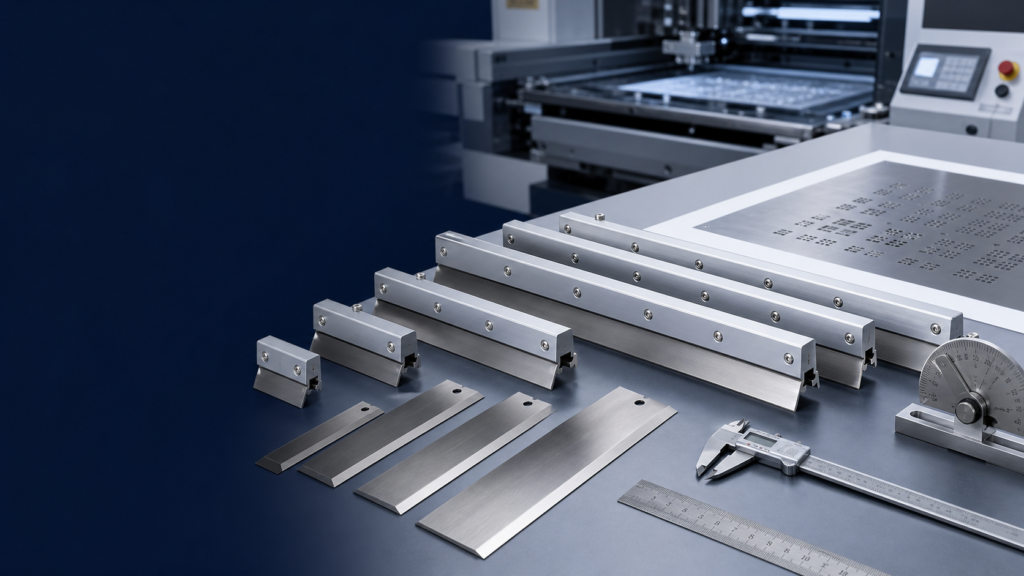
A replacement metal squeegee blade is the working component that contacts the stencil and moves solder paste across the printing area. Examples include DEK 129925, 133584, 133585, 129926 and 133586.
A squeegee holder assembly supports, clamps and positions the blade. Common DEK models include SQA301, SQA302, SQA303, SQA304, SQA305 and SQA306.
If the holder remains straight and undamaged, replacing only the worn blade may be sufficient. If the holder is bent, incomplete, damaged or incompatible with the printer mounting system, a complete squeegee assembly may be required.
Identify the Original Part Number
The safest way to select a replacement is to check the part number shown on the original packaging, label or maintenance record.
Do not identify a blade only by appearance. Many DEK metal blades have similar shapes and mounting holes but differ in working length, angle or holder compatibility.
Common DEK 60° blade and holder combinations include:
– DEK 129925: 200mm blade, compatible with SQA301
– DEK 133584: 250mm blade, compatible with SQA302
– DEK 133585: 300mm blade, compatible with SQA303
– DEK 129926: 350mm blade, compatible with SQA304
– DEK 133586: 400mm blade, compatible with SQA305
– DEK 129927: 440mm blade, compatible with SQA306
View our complete DEK Metal Squeegee Blade Selection Guide:
Select the Correct Blade Length
Blade length should match the required printing area and the existing holder configuration.
A blade that is too short may not cover the required stencil aperture area. An unnecessarily long blade may consume more solder paste and may not fit the installed squeegee assembly.
When replacing an existing blade, measure its working length and compare the measurement with the original part number. Do not use the total holder length as the blade length because the two measurements may be different.
Confirm the Blade Angle
DEK metal squeegee blades are available with different printing angles.
A 60° blade is commonly selected for normal solder paste aperture filling. A 45° blade can create a different filling action and may be used for more paste-intensive applications.
Changing from a 60° blade to a 45° blade should not be treated as a simple spare-parts substitution. The different angle may affect solder paste filling, pressure requirements and the established printing process.
When replacing a blade, use the same angle as the original product unless the printing process has been evaluated and approved for a change.
Check the Overhang
Overhang is the unsupported section of the blade extending beyond the holder.
DEK metal squeegees are available with different overhang configurations. Two blades with the same working length may therefore not be interchangeable.
Before ordering, confirm:
– Blade working length
– Blade angle
– Overhang
– Mounting-hole quantity
– Mounting-hole position
– Blade thickness
– Blade profile
– Compatible holder model
Check the Mounting-Hole Pattern
Replacement blades can appear nearly identical in photographs. However, small differences in mounting-hole position or spacing can prevent correct installation.
When the original part number is unavailable, provide a clear photograph of the complete blade and close-up images of its mounting holes. Include accurate measurements whenever possible.
Metal or Polyurethane Squeegee?
Stainless-steel and polyurethane squeegees are intended for different printing requirements.
Stainless-steel squeegees are widely used in SMT printing with metal stencils. They are suitable for many assemblies containing a mixture of large, standard and fine-pitch components.
Polyurethane squeegees are available in different hardness ranges and can be selected for single-thickness, multi-level or specialized stencil applications.
Do not replace a polyurethane blade with a metal blade, or a metal blade with a polyurethane product, based only on matching length. Blade material forms part of the printing process and should be confirmed before ordering.
Confirm the Compatible Holder
The replacement blade and holder must form a compatible combination.
For example, the DEK 133584 250mm replacement blade is commonly associated with the SQA302 holder. The DEK 129926 350mm blade is commonly associated with the SQA304 holder.
View our DEK Squeegee Blade Holder Selection Guide:
Information to Provide When Requesting a Quote
To help identify the correct product, provide as much of the following information as possible:
– DEK or ASMPT part number
– Holder model, such as SQA303
– Required blade length
– Blade angle
– Blade material
– Photograph of the complete product
– Close-up photograph of the label
– Photograph of the mounting holes
– DEK printer model
– Required quantity
Need Help Selecting a DEK Squeegee Blade?
If the original part number is unavailable, send us clear photographs and measurements of the blade and holder. We can help compare the available DEK squeegee products and check the appropriate replacement before quotation.
If you are experiencing inconsistent print results or are unsure whether the blade needs replacement, read our SMT Squeegee Blade Inspection and Replacement Guide:
When Should You Replace an SMT Squeegee Blade? Signs and Troubleshooting
For general manufacturer information, visit the ASMPT official squeegee product page:
https://smt.asmpt.com/en/products/process-support-products/squeegees/